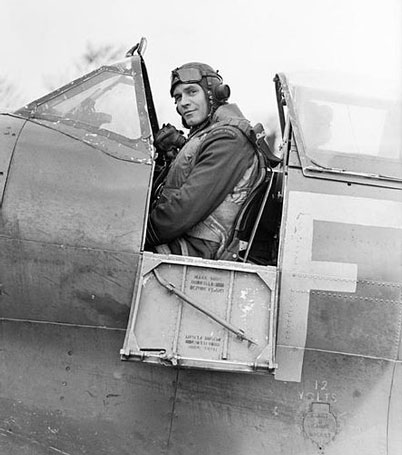
Adolph Gysbert Malan — known to the world as Sailor Malan — was one of the most celebrated fighter pilots of the Second World War. A South African-born Royal Air Force ace, he became a legendary figure of the Battle of Britain, flying the aircraft that came to symbolise resilience, determination and courage: the Spitfire.
But Sailor Malan’s story is about far more than his achievements in the skies. It is the story of a man guided by a strong sense of justice, a willingness to stand up for what was right, and a belief that courage was something to be lived, not simply celebrated.
Born in Wellington, South Africa, in 1910, Sailor’s early life was shaped by challenges that would influence the man he became. As a young cadet aboard the training ship General Botha, he experienced strict discipline and hardship, developing the resilience, self-reliance and determination that would later define his RAF career.
After working as a merchant sailor and travelling the world, Sailor joined the Royal Air Force as war approached. He was not an immediately natural pilot, but his exceptional eyesight, coordination and skill with a rifle helped him become one of the RAF’s most accomplished fighter pilots.
Flying Spitfires during the Second World War, Sailor took part in some of the most significant battles of the conflict, including the defence of Britain during 1940. He became commanding officer of the famous 74 Squadron, whose motto was: “I Fear No Man.”
These words reflected more than a fighting spirit. For Sailor, they represented the courage to face danger, challenge injustice and stand firm in the face of adversity.
A brilliant tactician and respected leader, Sailor developed his famous “Ten Rules of Air Fighting”, principles that continue to be studied by pilots today. He achieved 27 aerial victories and was awarded numerous honours, including the Distinguished Flying Cross and Distinguished Service Order.
Yet Sailor never saw himself as a hero. He believed the achievements of the Battle of Britain belonged to the many — pilots, ground crews, engineers and countless others who worked together in defence of freedom. He often redirected praise towards those who served alongside him.
After the war, Sailor returned to South Africa. However, his fight for justice did not end with the defeat of fascism in Europe. Disturbed by the rise of apartheid, he used his public profile to oppose policies that conflicted with the values he had defended during the war.
As President of the Torch Commando, an organisation formed by former servicemen and women opposed to apartheid, Sailor once again demonstrated the courage that had defined his wartime service. He was prepared to face criticism and personal attacks because he believed standing against injustice was the right thing to do.
Sailor Malan passed away in 1963 at the age of 52. While his life was cut short, his legacy continues to inspire. He is remembered not only as a remarkable Spitfire pilot, but as a man whose courage extended far beyond the battlefield.
His story reminds us that courage is not the absence of fear — it is the decision to act despite it. Whether facing enemy aircraft in the skies above Britain or injustice on the ground in South Africa, Sailor Malan always chose to stand firm.
As the motto of 74 Squadron declared: “I Fear No Man.” A fitting tribute to a man whose life embodied courage, integrity and an unwavering commitment to doing what was right.
And, we are delighted to have one of Sailor’s relatives, Yvonne Malan as one of our esteemed Aces. Many thanks Yvonne for sharing Sailor’s story.
Source: Sailor Malan Memorial Lecture, titled “‘I FEAR NO MAN’ – The Life and Legacy of Sailor Malan“, presented by Dr. Yvonne Malan.
Privacy Policy & Cookie Policy
All content © 2026 National Spitfire Project National Spitfire Project, Registered Charity No. 1158286
Website designed and built by MindWorks Marketing
